
A newborn cannot distinguish between day and night, demands breast or bottle every two to three hours, and communicates almost exclusively through crying. For parents experiencing these first months with a baby, daily life oscillates between wonder and accumulated fatigue. The benchmarks evolve quickly: care practices that were still recommended a few years ago are now being questioned, and advice varies from one health professional to another.
Infant Hygiene and New Regulatory Constraints
Diaper changes, baths, and nasal cleaning mark the day. A recent change in nasal and ear hygiene practices alters habits: the EU Regulation 2025/2487, which came into effect in January 2026, bans plastic cotton swabs for babies throughout the European Union. Alternatives made of biodegradable cotton or saline solution pods are becoming the norm for clearing the airways of a congested infant.
For bathing, the consensus among pediatricians remains two to three times a week during the first weeks, unless there is particular soiling. A daily bath dries out the newborn’s skin, whose hydrolipidic film is still fragile.
Using lukewarm water, checked with the elbow or a thermometer, and a fragrance-free moisturizing soap is sufficient. For parents who want to discover baby with Maman au Quotidien, these basic gestures are complemented over the weeks by observing the child’s reactions.

Baby Sleep and Managing Parental Support at Night
Sleep is the primary concern for most young parents. A newborn sleeps in short cycles, often lasting forty to fifty minutes, and wakes several times a night to feed. Trying to establish a regular rhythm before six to eight weeks is unrealistic: the baby does not yet have the neurological maturity to differentiate between day and night.
Setting Benchmarks Without Forcing a Rhythm
Some signals help the newborn gradually integrate the day-night alternation:
- Maintain natural light and the usual household noises during daytime naps, then dim the lighting and reduce stimulation in the evening.
- Establish a short sequence before bedtime (diaper change, pajamas, lullaby, or skin-to-skin) that will become a recognizable ritual.
- Lay the baby on their back in a crib without a duvet, pillow, or bumper, in accordance with recommendations to prevent sudden infant death syndrome.
The bedtime ritual does not produce immediate effects. It works through repetition over several weeks. Feedback from parents varies on this point: some newborns respond quickly, while others take more than two months to extend their nighttime sleep periods.
First Months in Single Parenting: Logistics Without Support
Most guides for young parents assume a two-adult setup, with possible support at night or during bath time. For a solo parent, this organization does not hold. Managing sleep and care simultaneously without support requires rethinking every daily gesture.
Adapting Routines to One Pair of Hands
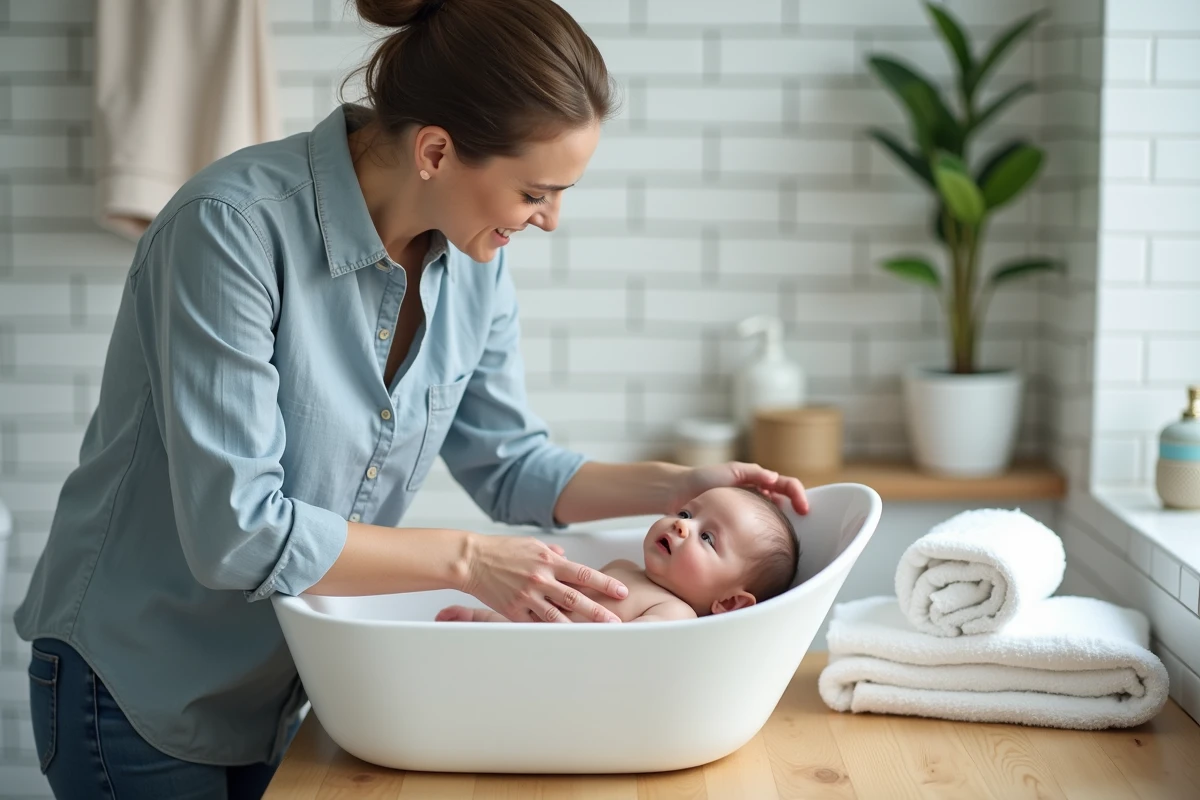
The bath illustrates this constraint well. When alone, placing the newborn in a rigid bathtub on the floor or on a stable surface allows for keeping both hands free, without needing someone to hold the child. Preparing all the materials before undressing the baby (towel, onesie, diaper, washing product) avoids unnecessary trips back and forth.
For nighttime, a co-sleeping bed attached to the parental mattress reduces movement during frequent awakenings. The parent can breastfeed or bottle-feed in a semi-reclined position, then lay the baby back down without getting up. Limiting nighttime movements reduces sleep debt, a critical issue when no support is available in the early morning.
Anticipating Moments of Overwhelm
The exhaustion of a solo parent cannot be resolved solely through logistical tips. Support structures (PMI, single parent associations, occasional daycare) exist but are unevenly distributed across the territory. Identifying these external supports before birth, during pregnancy, allows for activating a network when fatigue becomes unmanageable.
A rarely addressed point: accepting that some tasks will not be done. Cleaning, tidying, or preparing elaborate meals take a back seat during the first weeks. A newborn needs care, milk, and presence, not a spotless home.
Skin-to-Skin Contact and Attachment Bonding in the First Months
Skin-to-skin contact, practiced from birth in the maternity ward, has measurable effects on the newborn’s thermal regulation and heart rate. Its practice is not limited to the first hours of life. However, the available data do not allow for precise quantification of its long-term effect on attachment bonding.
What we do know: a newborn carried skin-to-skin cries less and falls asleep more easily. The parent, for their part, learns to decode the baby’s bodily signals (sucking movements, restlessness, muscle relaxation). This decoding sharpens with repetition, regardless of the chosen feeding method.
Skin-to-skin works just as well with the father or second parent as with the mother. For single-parent families, this moment of contact can serve as a decompression zone after a busy day, provided the parent finds a comfortable and secure position.
The first months with a baby are not just a checklist of tasks to complete. Each child imposes their own rhythm, and standardized responses never cover all situations. The most useful approach often remains to observe, adjust, and allow oneself to ask for help when needed, regardless of the family configuration.