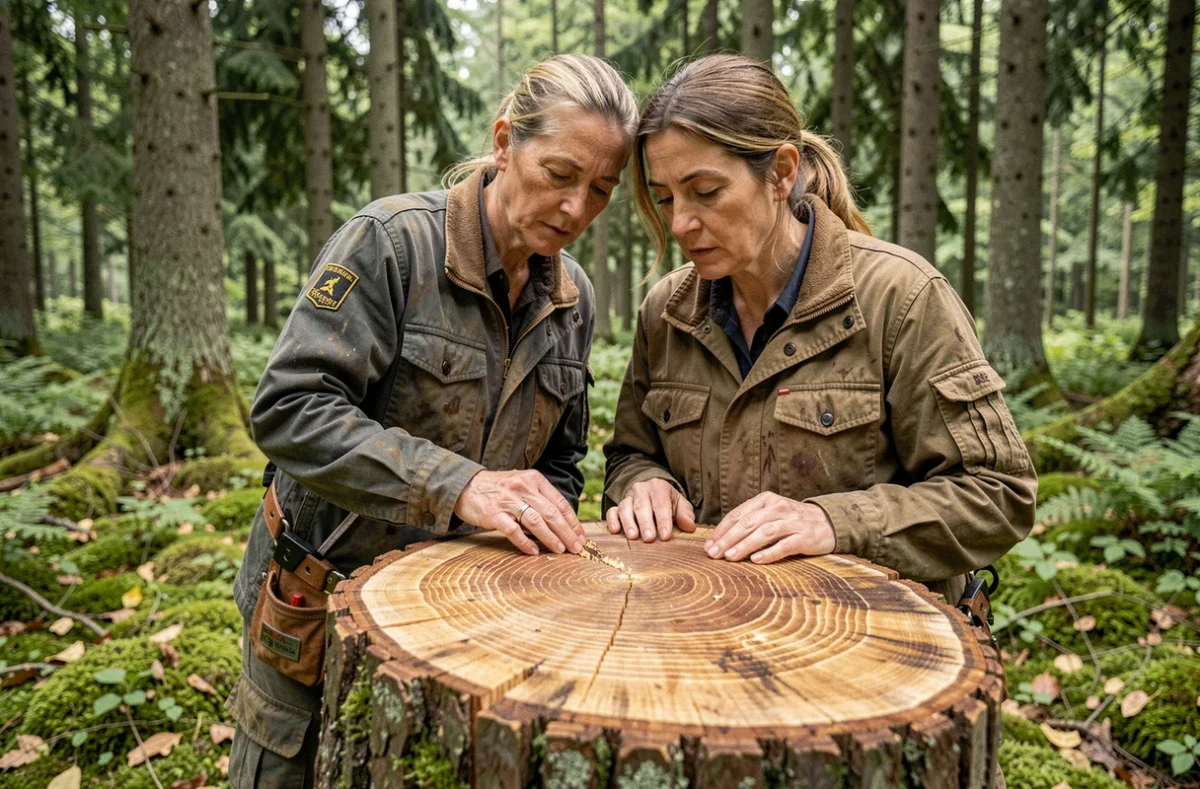
Let’s decrypt together the mystery of a thirty-year-old tree, a well-kept secret. Natural clues speak to us; the growth rings. Each year, a new ring, a new story to tell. The bark, a silent witness to external elements, reveals its secrets to the most attentive. Science lends us its tools; dendrochronology, the study of rings, and radiocarbon dating, scrutinizing the tree’s DNA. These rigorous methods reveal the age of a tree with disconcerting precision. Yet, determining the age of a thirty-year-old tree is not an end in itself, but the beginning of an interpretation, the opening of a dialogue with nature.
Unveiling Natural Clues: The Growth Rings
Nature has this incredible ability to keep traces of its history. A striking example is that of trees whose rough bark harbors the secrets of years gone by, visible through their growth circles. These concentric bands reveal much more than their age. Each ring is a window into a specific year in the life of a tree: they unveil the environmental conditions it has been exposed to, such as climate and water availability.
The study of these rings thus offers us an accelerated course on the Earth’s climatic past, a valuable tool for scientists seeking to understand how our planet is changing. This method, known as dendrochronology, allows us to explore climate variations over time and helps predict what might happen in the future environment due to climate change.
The rings can also serve to identify significant historical events that have impacted nature, such as a major volcanic eruption or an exceptional drought. Furthermore, these rings are also capable of indicating diseases, pests, or other stresses experienced by the tree during its life.
Each ring thus represents a unique page in the great chronicle written by Mother Nature herself • each line offering a new secret to decipher for those who know how to read between them. They also reflect the deep connection that exists between the tree and its environment.
Understanding External Elements: The Bark and Its Story
Through the ages, nature has always been a valuable indicator of the evolution of our planet. In particular, the bark of trees, a true living memory, holds much more information than it appears at first glance. Scientists have discovered that the secret of the bark lies in its ability to retain traces of past environmental and climatic conditions.
By closely observing this protective outer layer that surrounds our forests, we can travel back in time and understand how weather conditions have influenced their development. The study of these remarkable natural archives allows for a better understanding of past but also current climate changes.
Dendrochronology is the science dedicated to the meticulous study of the annual growth rings present in the trunk of a cross-sectioned tree. Each ring represents a year of the plant’s life; thus, by analyzing their widths or densities, it is possible to identify significant climatic variations that have occurred over time.
One of the crucial pieces of information that decoding the bark provides concerns the dry and wet periods during its annual cycle. For example, a harsh winter leaves an indelible mark on the corresponding ring, while a prolonged warm season generally creates a narrower ring.
Scientific Methods: Dendrochronology and Radiocarbon Dating
Science offers various tools that allow us to explore and understand our world, particularly two valuable methods for understanding the past: dendrochronology and radiocarbon dating. These two approaches combine knowledge in physics, chemistry, and biology to decode the mysteries inscribed in wood and organic residues.
One of the oldest natural sciences at our disposal is dendrochronology. This method exploits the idea that each year, a tree gains a new growth layer visible as a “circle” on its cross-section. By comparing these circles or annual rings with those of other trees of the same species but of different ages, a relative chronology can be established that sometimes spans several millennia.
The primary role of this technique is not only limited to determining the age of trees but also provides a wealth of valuable information about the environment in which they lived; which has greatly contributed to our current knowledge regarding past climate changes.
On the other hand, radiocarbon dating, also known as carbon-14 dating, is primarily used to determine the absolute age of historical or prehistoric objects containing organic carbon, such as fossilized bones or ancient textiles.
Interpreting Results: Decoding the Age of a Thirty-Year-Old Tree
The age of a tree, and more specifically that of a thirty-year-old tree, raises a fascinating enigma. The analysis of this age is generally done through the scientific method called dendrochronology. This technique involves studying the growth rings of trees to determine their exact age.
To understand how this works, one must know that each spring and summer a new ring is formed around the trunk of the tree. Thus, by counting the total number of these concentric circles visible in a cross-section of the trunk, one can accurately estimate the age of the tree.
But where the situation becomes more complex is when it comes to assessing the age of a living tree without being able to access this complete cross-sectional view of the trunk. This is where interpretation comes into play. Indeed, several factors can affect the process of ring formation, such as annual climatic conditions (temperature and precipitation) or local resource availability (nutrients in the soil). A particularly difficult year environmentally could lead to slowed growth, thus making the rings less visible.
Thus, if you find yourself facing a magnificent tall oak and the question arises: “How old is it?”, one must take these various factors into account to provide an approximate but reasonably accurate answer.