A rental accommodation can consist of people with high and low mobility. It is especially important to adapt the housing (the toilets) to the lifestyle of disabled individuals. Such adaptations require equipment and layout methods. To help you with this, we present in this article how you can design toilets for people with reduced mobility.
What needs to be done primarily
Like all rooms in a home, the toilets must be designed to allow for good circulation. Take the opportunity to do the same in the bathrooms. To ensure this, several conditions must be met.
First, it is imperative that the disabled toilet door opens outward and has a minimum width of 90 cm. Next, ideally, the door’s swing should be 1.7 meters. Finally, to facilitate the installation of toilets for disabled individuals (PRM), it is necessary to allow a distance of 1 meter between the toilet and the wall.
How to equip and design toilets for disabled individuals?
To properly design toilets for disabled individuals, three main pieces of equipment are needed. We have the installation of:
Raised toilet or PRM toilet
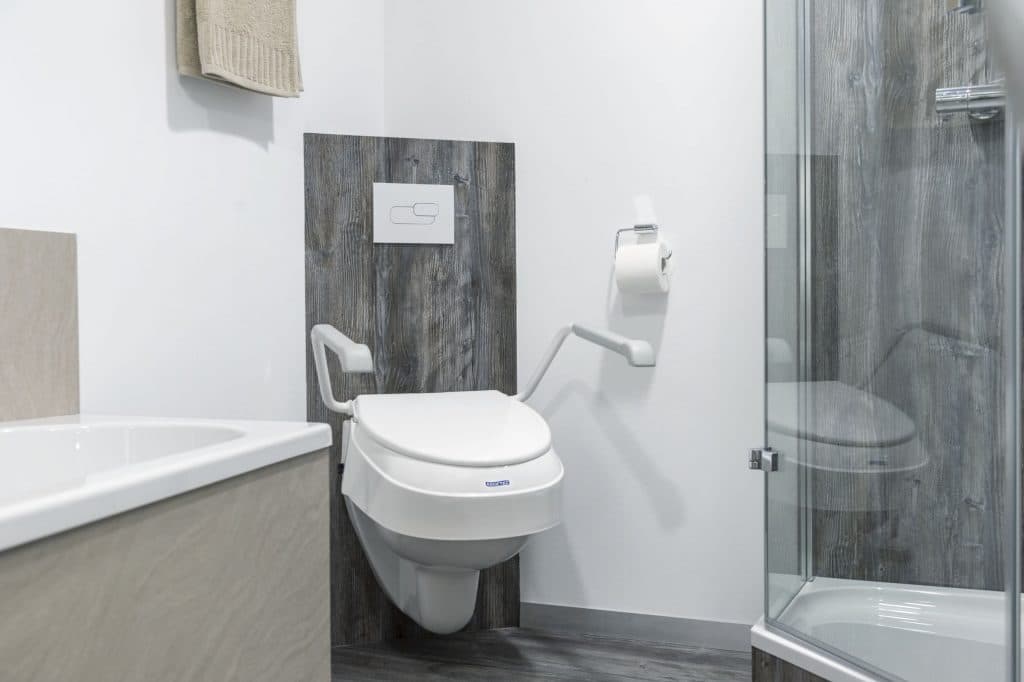
The design of PRM toilets cannot do without the use of this type of toilet. It features a raised bowl, up to about 50 cm in height. Wall-mounted bowls with armrests are also alternatives. With this solution, the disabled individual can set the height of the toilet according to their preference.
Installing a toilet seat for disabled individuals would be an asset not to be overlooked. Choose the most comfortable and aesthetically pleasing option. There are many models made of heating materials and bidets.
Support bars
It would be ideal to install at least one in the toilets to create a perfect environment for people with reduced mobility. This support bar must be securely fixed to the wall of the PRM toilets. This will help disabled individuals avoid sudden movements. Everything will be much simpler for them when they are there. To provide more comfort, an additional horizontal bar can be installed.
Sink for disabled individuals
To ensure a successful layout, here is the finishing touch. This element is both interesting and important for the comfort of PRM. Thus, the disabled individual will be able to wash their hands quickly and will not have to move to another room to do so.
Consider using lower sinks or sinks whose height takes into account the wheelchair of the PRM. Keep this in mind not only for the sinks but also for other toilet equipment, such as the mirror, soap dispenser, and towel placement, etc.
Such a layout in the toilets provides greater ease for disabled individuals.
PRM toilet design: what standards are provided for this purpose?
These simply take into account accessibility to the doors for PRM. The area of PRM toilets. Accessibility to the bowl and various equipment. For this, the height of the chair of the person with low mobility must be considered. The installation of a support or grab bar is also required.