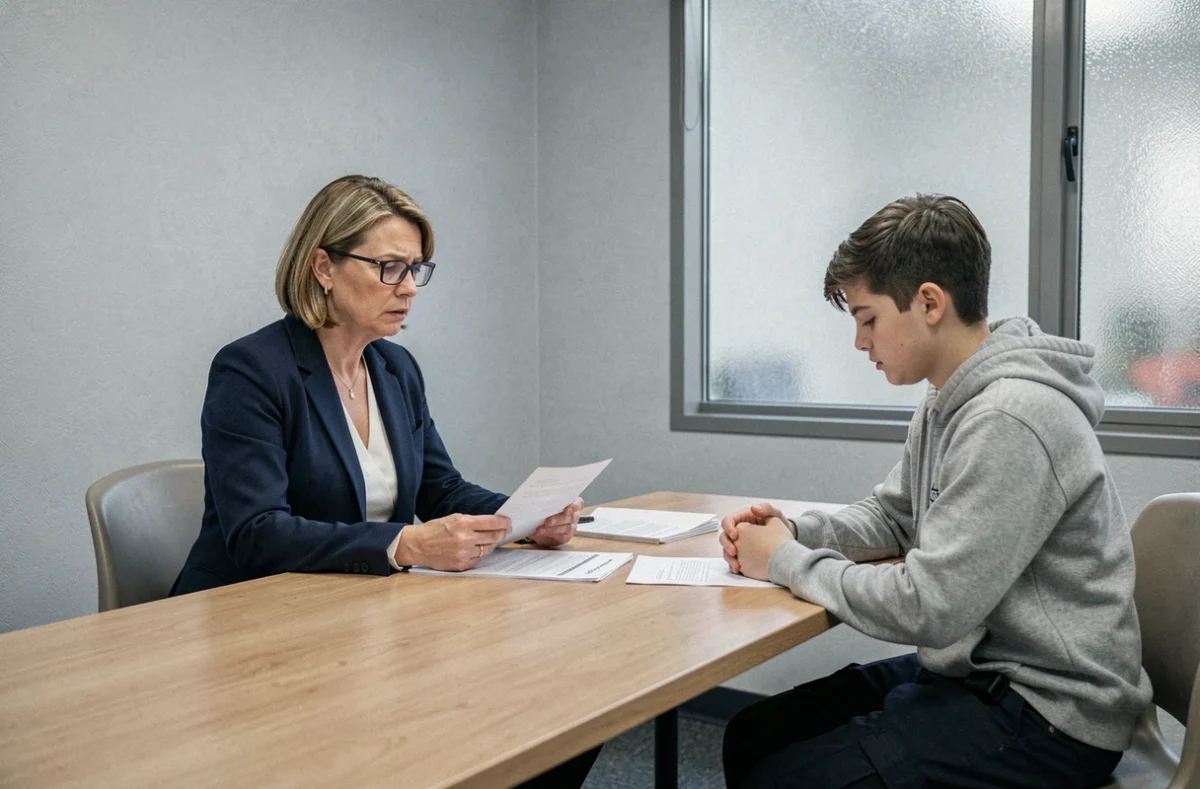
Article L. 413-9 of the Code of Juvenile Criminal Justice (CJPM) establishes a principle that criminal practice cannot circumvent: the lawyer is mandatory from the start of a minor’s police custody, with no possibility for the minor to waive this right. The entire procedural framework surrounding the questioning of a minor stems from this requirement, which has been reinforced since the CJPM came into effect in 2021.
Minor’s Police Custody: The Procedural Lock on Legal Assistance
A minor placed in police custody does not have the option to refuse the assistance of a lawyer. If their legal representatives do not appoint one, the bar association is called upon to appoint one ex officio. This obligation allows for no exceptions, even when the minor is being questioned for minor offenses.
The appointed lawyer must be able to attend all hearings and confrontations. Their role is not limited to passive presence: they verify the material conditions of the measure, ensure compliance with deadlines, and can submit written observations to the file.
Analyses published on the Petites Graines website remind us that this procedural architecture aims to compensate for the structural vulnerability of the minor in the face of investigators, a vulnerability that the mere presence of a parent does not suffice to cover.

Parental Rights During a Minor’s Questioning: Presence and Limits
We regularly observe confusion between the parents’ right to be informed and their right to physically attend the hearing. The two do not overlap.
Mandatory Information for Legal Representatives
From the moment of placement in police custody, investigators must inform the legal representatives. This obligation concerns the nature of the measure, the alleged facts, and the rights of the minor. Parents can also designate the lawyer who will assist their child.
Presence at the Hearing: A Conditional Right
Investigators can exclude parents from the hearing room. Their presence is not an absolute right during the questioning itself. In practice, several reasons justify this exclusion:
- A risk of direct or indirect pressure on the minor’s statements, particularly when a parent is involved in the facts or in the context of the offense.
- The necessity to preserve the sincerity of the statements, a guiding principle of the criminal investigation that takes precedence over parental comfort.
- The material impossibility of contacting the legal representatives within a reasonable time, without hindering the progress of the measure.
The Use of an Appropriate Adult
Article L. 311-2 of the CJPM provides for a mechanism often overlooked. The minor can request that another adult, referred to as an “appropriate adult,” receive the information and accompany them in place of the legal representatives. This provision is activated in three scenarios: notifying the parents would be contrary to the best interests of the child, it is impossible despite reasonable efforts, or it could severely compromise the procedure.
The appropriate adult replaces the parents in their accompanying role, not in their parental authority. They do not make any legal decisions for the minor.
Civil Hearing and Criminal Questioning: Two Regimes Not to Be Confused
The questioning of the minor before the family court judge (Article 388-1 of the Civil Code) follows a radically different logic from questioning in police custody. Confusing the two regimes leads to errors in procedural strategy.
In civil matters, a minor capable of discernment has a right to be heard by the judge regarding decisions that affect them (residence, visitation rights, parental authority). This right is personal: it belongs to the child, not the parents. The judge cannot refuse the hearing requested by the minor themselves, unless they specifically justify their decision.
In criminal matters, the minor is not heard at their request but because they are a suspect or implicated. The procedural framework is more stringent, the guarantees more numerous, and the lawyer’s role more active.
Minor’s Discernment: A Variable Criterion
Discernment is the pivot of both regimes. In civil matters, it conditions the minor’s right to be heard. In criminal matters, it conditions the very possibility of holding them accountable.
No age threshold defines discernment in the Civil Code. The judge assesses on a case-by-case basis the minor’s ability to understand the situation and to express an opinion. The minor’s maturity is assessed concretely, not by reference to a minimum age.
We recommend that practitioners document the minor’s maturity with objective elements (school reports, educational assessments, exchanges with the minor) rather than relying solely on the age criterion, which courts consider insufficient.
Procedural Strategy: What Parents Should Anticipate
When a minor is apprehended, the parental reaction in the first hours conditions the continuation of the procedure. Quickly appointing a criminal lawyer specialized in juvenile law avoids resorting to an ex officio appointment, where the designated practitioner may not always have specific expertise.
Parents must also understand that their role during police custody is one of support, not direction. Any attempt to influence the minor’s statements, even well-intentioned, can be held against them.
In civil matters, preparing the minor’s hearing with a dedicated lawyer (distinct from that of the parents) ensures that their words will not be perceived as a relay of parental discourse. Family court judges are trained to detect “coached” statements, and a statement perceived as manipulated loses all evidential weight.
The distinction between support and influence remains the fine line on which the minor’s credibility hinges, whether before a judicial police officer or a civil judge.